☆ DRUMS
 WORK IN PROGRESS!
This page details how to author the standard and pro 4-lane charts for Drums to be played with a drum controller or MIDI drumset.
☆ Introduction
Charting Drums for Rock Band consists of creating a pretty close and mostly accurate representation of the actual drum part in the song. While some adjustments have to be done for things like multiple cymbals and toms on occasion, the basics are mostly 1:1, and can actually teach the player how to perform the song on a real drum kit in a rudimentary way.
To start with, you'll want to understand the basics of playing drums, and which part of the set makes which sounds. Simply playing some Rock Band Pro drums can be enough to get a grasp of this, though looking up drum tutorials online is also useful.
 When you're ready to chart, keep in mind which parts of the drum chart usually corresponds to the actual drums:
- Orange Kick - Bass Drum
- Red Drum = Snare
- Yellow Drum = Tom 1
- Blue Drum = Tom 2
- Green Drum = Tom 3
- Yellow Cymbal = Hi-Hat
- Blue Cymbal = Ride
- Green Cymbal = Crash
☆ Layout

- Notes - Where you put the playable notes.
- Solo Marker - Marks the duration of the note as a solo, meaning it will count your note-hit progress for the section and give you a bonus in-game.
- Tom Marker - Marks a note to show up as a tom when playing Pro Drums. Works for Yellow, Blue and Green.
- Overdrive - See its own page for detailed explanation
- Drum Fill - Marks a spot that will allow you to activate Overdrive.
- Roll Marker 1-Lane - Creates a “roll lane” on one drum or cymbal for the duration of it, used for parts with burst rolls or cymbal swells to help make it more playable. Use sparingly!
- Roll Marker 2-Lane - Creates a “roll lane” on two drum or cymbal for the duration of it, used for parts with cymbal swells to help make it more playable. However, we recommend not using this one, as the hit window for it is completely messed up and could actually create fake difficulty instead of helping.
0. Double Kick Pedal Note - This note is only for PC clone games. Put any kick pedal drums you'll have to reduce for single pedal in here, and it will allow you to pick the Expert+ difficulty that includes them in those games. See further down on the page for how to handle double bass authoring in Rock Band.
Some of these will be explained in greater detail later.
On the bottom of the MIDI editor window there are additional options next to the play button:

- Grid (A) - The note density when placing notes. In most cases its fine at 1/16th, but you might sometimes need to change it to 1/32th for faster songs.
- Grid (B) - Changes which rhythm the grid uses. Straight is the default. Triplet is often used in Blues, Swing is often used in Jazz, and Dotted is very rarely used at all.
☆ EXPERT
Will add pictures
The hardest difficulty, and the part that should try and be as close as possible to the real song in terms of note density and rhythm. You want it to feel as close to playing the real thing as possible within the limitations of the game itself and the engine. Here are some of the basics to keep in mind:
- Think about what is played, and how - Try to visualize how the drum part is played when charting. If you're unsure how something is played, look up drum tutorials and tabs online to see if they might help (though don't rely on them entirely as they could be inaccurate)
- Consistency & Wrapping - In most cases, you'll want to keep it consistent which toms and cymbals you chart to which note lane. This can be fudged however in cases where the original drummer have extra toms and cymbals and it would play better if wrapped a bit, for example during drum fills containing more than 3 different toms.

- Flams - A flam is when you hit one or two drums almost at the same time, creating a fuller sound. These should simply be charted as double drum notes played at the exact same time, to prevent fake difficulty. For example, a flam played on the snare should be authored as a Red/Yellow Tom double hit.
- Open Hi-hats on Blue - A hi-hat cymbal can be opened or closed with a pedal on a real kit, however this is not programmed into Rock Band. Harmonix have sometimes charted these open hi-hats to Blue since it sounds fairly different from a regular closed hat, however this might feel weird when playing on Pro Drums. Its up to you how you wanna handle it, though we recommend only charting open hats to Blue in songs with electronic/programmed drums, where its more realistic to have this distinction. If it causes fake difficulty, however, we strongly advice against doing it at all.
- Double Bass Pedals -
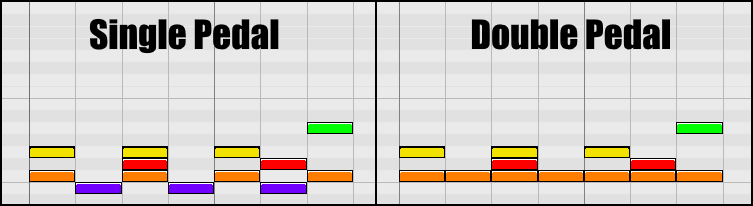 You'll want to reduce fast kicks where you need two pedals to play them in the main drum track, as the default Rock Band drums only has one pedal. You can, and should, chart them fully in a separate track however, using the track name “PART DRUMS_2X”. When done, this will build a double bass version along with the normal version in Magma, allowing people with an additional pedal to play the song as intended.

- People only have two arms and two legs maximum - You should never chart something requiring three hands to hit.
ADVANCED EXPERT AUTHORING
- Disco Flips - Sometimes a drum part will involve playing 16th notes as part of a beat with snares involved. On a real drum set, the hi-hat is usually to the left of the snare, making this natural. However, on a standard Rock Band kit the yellow pad is to the right of the red pad. To work around this, chart the hi-hats as Red, and the snares as Yellow cymbals, then add a text event [mix 3 drums0d]. This will make it so the notes appear swapped on standard drums, but are switched to the proper realistic way on pro drums. To switch the drums back to normal, put in the text event [mix 3 drums0].
Disco flips should not be authored on reductions, instead they should be treated like a normal drum beat on there, which means charting hi-hats at the same time as snares even if they technically don't exist in the audio.
- Ghost Hits - Sometimes drum parts involve hitting notes very softly, barely being audible in the mix if at all. In those cases, you should consider if they're worth authoring or not, depending on if they're an integral part of the drum beat or not. In most cases, chart the ones you can hear without needing to solo out the drum stem.
☆ HARD
Note Density
Hard drums should in general stick to 8ths, with some 16ths during fills allowed if a song is below 140bpm. You'll want it to feel like playing the song itself but without all the bells and whistles, essentially.
☆ MEDIUM
Note Density
Medium drums should in general stick to 4ths, though if the song is around 120pbm or slower you can have 8th time keepers with some gaps. This means you can chart a constant stream of hi-hats as long as you have a gap before it switches to something else, like a fill or a crash, as an example.
Medium-Specific Limb Rules
Medium shouldn't require full limb independence, and as such you wanna avoid certain things:
- No kicks under a double hand hit - For example, if there is a snare and a crash at the same time, you're not allowed to have a kick at the same time. Either chart it as a snare + crash, or a kick + crash on Medium.
☆ EASY
Note Density
Easy drums should in general stick to 4ths, authoring just the skeleton of the rhythm of the song.
Easy-Specific Limb Rules
Easy drums should never have you use more than 2 limbs at once at any time. In practice, this means any individual section of a song should be authored in one of two styles:
- Two hands, no kicks - Chart the cymbals, snares and toms as you would on higher difficulties, but leave out all kicks.
- Kicks and one hand - Chart the snares and kicks of the beat, but leave out all cymbals except for crashes.
You can have different reduction styles between sections, so for example you can have verses with just kicks and snared before moving over to just hands in the choruses.